The hour between daylight and night on the allotment is usually a time for quiet reflection, soundtracked by the defiant musical sophistication of a song thrush and the territorial singing of robins.
Even under an oppressive grey sky and the persistent misty drizzle of a late winter evening, the birdsong suggests a seasonal optimism that the sodden ground beneath one’s boots does not yet justify. It was in this atmosphere of damp enthusiasm that we set out to reclaim a lost territory, a piece of our allotment that previous allotmenters had abandoned.
In the world of the amateur horticulturalist, serendipity often dictates design. Our latest project—a boundary fence—was born not from a blueprint, not from sitting down over a glass of wine and mapping out what goes where, but on a whim and from the discovery of a weathered, yet serviceable, timber panel unearthed while searching for something entirely unrelated in the abandoned allotment next to ours.
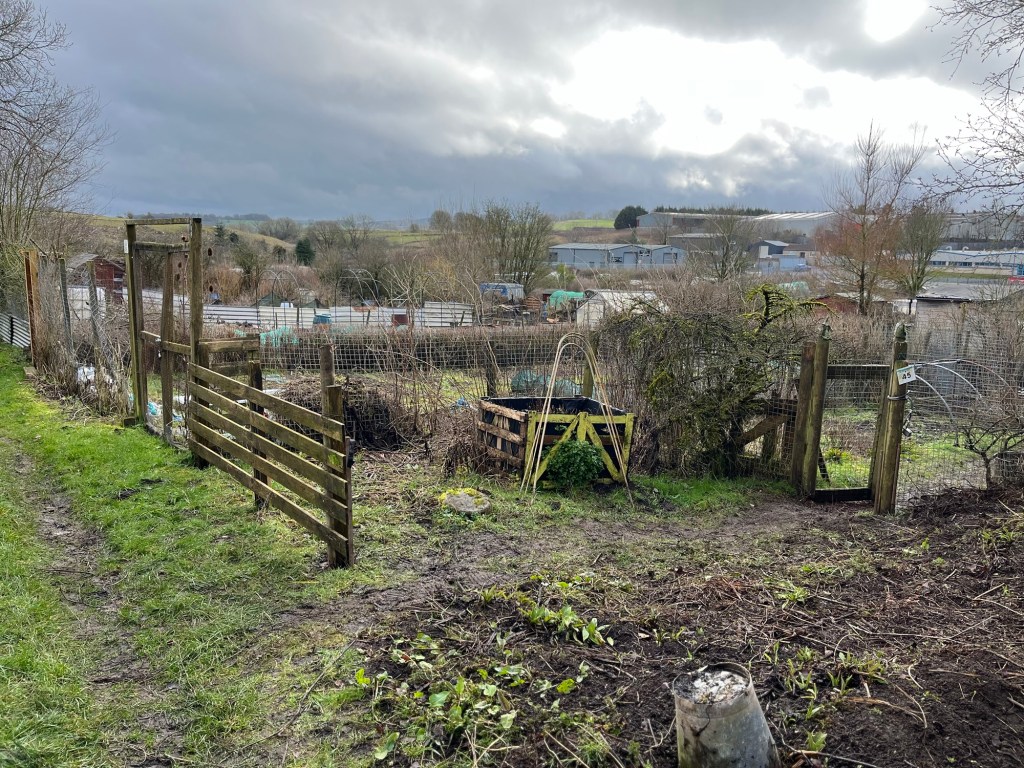
It was the catalyst we needed to rectify a historical curiosity: the previous tenants had, for reasons obscured by time, retreated their boundary by some twelve feet. No one seems to know why and the space has become a bit of a dumping ground for cuttings and general allotment waste.
To “reclaim the frontier” is a satisfying endeavour, but as Lindsey rightly observed, timber, especially slightly rotting timber, alone lacks soul. The solution was Salix—freshly harvested willow.
The Allure of the Living Fence
There is a primitive, almost meditative joy in planting willow. To the uninitiated, it looks like folly; to the gardener, it is the architecture of the future. We spent the fading light weaving these green sticks into the earth, a task so engaging that it blinded us to the logistical peril we had naively and somewhat lazily stumbled into.
In an act of hubris that would later haunt us, we eschewed the wheelbarrow for the convenience of the Skoda Superb Estate. While a triumph of Czech engineering, the Superb’s low-profile tires and substantial kerb weight are ill-suited for a narrow, rutted track transformed by months of rain into a muddy soggy unforgiving surface.
A Study in Traction and Scarcity
The descent however was effortless, lulling us into a false and misplaced sense of optimism. As we found later, the retreat, however, was a lesson in the physics of despair. As the light vanished, the song thrush and robins packed up and wisely went to bed, allowing the owls to take over the evening shift, our front-right wheel began to burrow with an alarming commitment into the soft earth the harder we tried to reverse back up the track.
But nothing is truly wasted on an allotment; it is merely a resource waiting for its moment, either to satisfy a creative moment of inspiration or to step in and help out in a crisis.
And just as we were thinking of leaving the car until the morning and trudging back home, we found, abandoned and ignored the heroic material.
When cardboard failed to provide the necessary friction, we turned to the “archaeology” of the neighbouring plot—an abandoned patch that had become a de facto repository for detritus. There, under the surgical beam of head torches, we discovered sheets of corrugated plastic.
We created a makeshift track, and combined with a vigorous, “tight-head” style shove against the radiator grille, the car finally broke the stasis. The Skoda ascended the slope with a stuttering dignity, eventually reaching the safety of the tarmac.
As we retired for a late dinner and the restorative heat of a dark roast coffee, the takeaway was clear. The allotment provides, often from the very “junk” we tend to disparage.
The fence is progressing and the willow supply remains plentiful. Next time, however, we shall be embracing the honest sweat of the barrow rather than the false promise of the internal combustion engine.

